Paint or Replace? How to Tell If Your Siding Needs a Repaint or a Re-Side
Does your siding need paint, or does it need replacing?
Paint and siding fail in different ways. When paint fails, the finish chalks, fades, cracks, or peels, but the board underneath is still firm and flat. When siding fails, the board itself softens, swells, splits, or comes apart, and paint, which is only a surface film, can't change that. If you're not sure whether your walls are failing or just dirty, start with our guide to telling failing siding from dirty siding. Then try three quick checks:
- Chalk: rub light paint with a dark cloth, or dark paint with a white one. Most paints chalk a little as they age; deep chalking, checking, or cracking means the paint is worn out.
- Mildew: put a drop of household bleach on a dark spot. Mildew typically turns white within a minute or two, while dirt stays dark. Either way, it's a cleaning job, not failing siding.
- Probe: on a dry day, press an awl or a small screwdriver into the wood where water sits longest: the bottom courses, window sills and trim corners, corner boards, and the walls under roof valleys, where the roof dumps water. Sound wood splinters when you pry it; decayed wood is soft and breaks off abruptly instead of splintering. Wet wood can feel soft even when it's sound, and a probe can miss decay in soft woods like cedar, so treat it as a first check, not a final answer.
What to look for, by material:
- Wood lap or shingle siding: paint peeling to bare wood is most often caused by moisture, from rain outside or from damp indoor air moving out through the wall. Once the water source is fixed and the wood has dried, firm boards are scraped, primed, and repainted; boards that fail the probe test need repair or replacement first.
- Hardboard: check the bottom edges and the nail heads. Swollen bottom edges, cracked paint along them, and cracks or dimples around the nail heads mean the board is failing. Solid wood shrinks back when it dries, but hardboard's swelling is permanent, and swollen hardboard soaks up water even more easily.
- T1-11 plywood panel: Washington's state historic preservation office lists T1-11 among the typical finishes of the Shed-style homes builders put up here from about 1960 to 1985. Once water gets in, the plywood layers can swell and come apart, usually at the bottom edges near the ground. That's panel failure, not paint failure.
- Fiber cement: intact boards with a faded or chalky finish just need paint, and James Hardie siding can be repainted. Cracked, broken, or missing pieces are different: James Hardie's touch-up is meant only for spots about the size of a dime, and for anything larger, its guidance is to replace that section.
Paint that keeps failing. Paint that keeps peeling to bare wood on the same walls points to water, which the USDA Forest Products Laboratory calls the most common cause of early paint failure on wood. Our guide to how wind-driven rain gets behind siding covers the usual paths.
Before you book a painter, press an awl into the bottom course of siding on your wettest wall, on a dry day. If the wood splinters, you're likely looking at a paint job. If it's soft or snaps off abruptly instead of splintering, that's a problem paint won't fix.
When does replacing make more sense?
Paint can't fix a failing board. Rotted wood has to be repaired or replaced before repainting, and paint over an unsolved moisture problem simply fails again. Replacing makes more sense when:
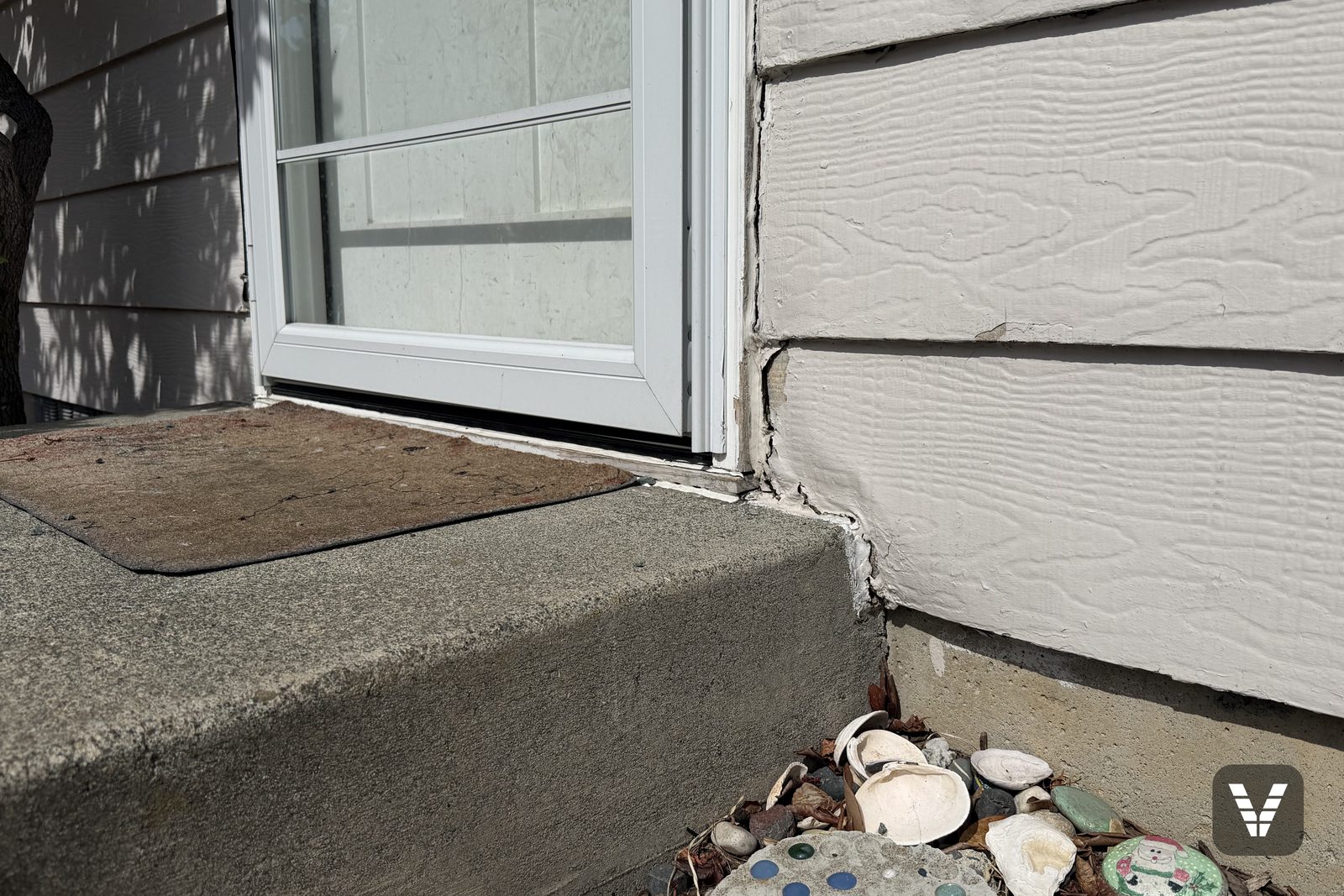
- Boards are swollen, split, or separating. Swollen hardboard won't go back down, and plywood panels coming apart at the bottom edges are failing, not just faded. The photo below shows cracked, swollen siding beside a front step on an Anacortes home we re-sided.
- Rot shows up on more than one wall. One or two soft boards are a job for siding repair or rot repair. Soft spots on several walls raise the bigger question of the sheathing behind them, and a re-side opens the whole wall so it can be inspected and repaired.
- The paint won't stay on. James Hardie lists siding that's chipped or cracked and needs frequent repainting as a sign it's time to re-side. Paint that has cracked across the grain has to be stripped completely before repainting, and so does alligatoring that has reached bare wood and started to flake; on a pre-1978 home, that's lead-regulated work, and it still leaves you with the same siding.
Repaint vs. re-side cost. On sound siding, a repaint costs less and is the right call. On failing siding, it buys time, not a fix: paint won't stop decay that's already started, and the cost comes back with the next repaint. A re-side costs more, but you pay for it once. Around Bellingham, prefinished James Hardie siding typically runs $11–$16 per square foot of wall, installed with the tear-off of the old siding, and most whole-home re-sides typically land between $20,000 and $60,000. Before sales tax, a home of about 1,500 sq ft typically runs $25,000–$38,000, about 2,000 sq ft $28,000–$45,000, and about 2,500 sq ft $38,000–$50,000. Our siding replacement cost guide has the full breakdown.
Prices change often with inflation, material costs, the economy, and tariffs and other policy changes, so these ranges are a guide, not a quote. Your written estimate has the current price for your home.
What a re-side includes. Our standard re-side starts with a full tear-off, so the wall can be inspected and repaired before anything new goes on. On a full-home re-side, rotted sheathing is typically replaced at no extra cost; on a partial re-side, it's decided case by case. Anything past the sheathing is very uncommon and is quoted as a change order, as outlined in your contract. We only install over existing siding when it's flat, structurally sound wood panel siding that passes a probe test with a scratch awl; our guide to putting new siding over old siding explains why.
The finish. James Hardie is the only siding we recommend for the Pacific Northwest, and Siding & Window Vault is a James Hardie Elite Contractor. Most of our re-sides use prefinished ColorPlus siding: the color is applied at the factory, so there's no painting the walls on installation day. Right now, James Hardie backs that finish with a prorated 15-year limited finish warranty; check James Hardie's website for current terms. Like any exterior finish, it's typically repainted at some point over the life of the siding; our guide to prefinished vs. primed Hardie siding has the details. For whole-home siding clients, we build a free 3D rendering of your home, so you can see the colors you're considering on your actual house before you choose.
When is paint the answer?
When the boards are firm, flat, and intact and only the finish is worn, the siding needs paint, not replacing. First, fix whatever is letting water at the wall: leaking gutters, failed flashing, damaged roofing, cracks and holes in siding and trim, worn caulk, and shrubs or sprinklers keeping the siding wet. New paint over an unsolved moisture problem just fails again.
How often. On wood siding, paint typically lasts about 5 to 10 years, depending on the preparation, the number of coats, and how much sun and rain the wall takes; the USDA Forest Products Laboratory says two topcoats over primer can last about twice as long as one. James Hardie doesn't publish a repaint schedule for fiber cement, and the 15 years on the ColorPlus warranty is a warranty term, not a repaint date, so repaint when the finish shows wear, not by the calendar.
Timing. In Bellingham, NOAA's 30-year averages put the typical overnight low near 34°F from December through February, with measurable rain on about 19 days a month from November through January. Even cold-weather exterior paints are typically rated only down to about 35°F, and paint makers typically want a dry wall, at least a day after heavy rain, plus a few hours of drying before evening dew settles. So exterior repaints here are typically planned for the drier months, and a primer coat shouldn't sit through the winter waiting for a spring topcoat.
Lead. If your home was built before 1978, Washington's lead-safe rules cover paid exterior work that disturbs more than 20 square feet of painted surface, including a painter's scraping and sanding. A whole-house repaint easily passes that line, so the painting firm needs to be certified, unless a certified renovator's test or a certified inspector shows the paint is lead-free. Right now, Washington's Department of Commerce runs the program, so check its lead-based paint pages for current rules, and ask any painter you're considering for their certification. Siding & Window Vault is Lead-Safe Certified by the State of Washington.
Prep. Wash the walls with a garden hose and a soft brush and let them dry. On wood siding, scrape loose paint, prime bare wood, and replace worn caulk with a permanently flexible sealant. On James Hardie siding, skip the pressure washer (James Hardie doesn't recommend high-pressure washing; if one is used anyway, it should stay under 1,500 psi with a wide fan tip, at least 6 feet from the wall), and on ColorPlus, James Hardie calls for a clean, dry, mildew-free surface and a 100% acrylic topcoat; new primer usually isn't needed. Once it's painted over, James Hardie's finish warranty no longer applies, and any paint warranty comes from the paint maker. Our fall walk-around covers the yearly checks between repaints.
Siding & Window Vault doesn't take standalone repaint jobs. We paint as part of our siding projects, primed James Hardie plus the trim and other areas we repair alongside it, and we quote the painting as its own line.
If your siding just needs paint, we recommend Hilltop Painting, a local painting company we know well and trust. They paint home exteriors across Whatcom and Skagit counties.