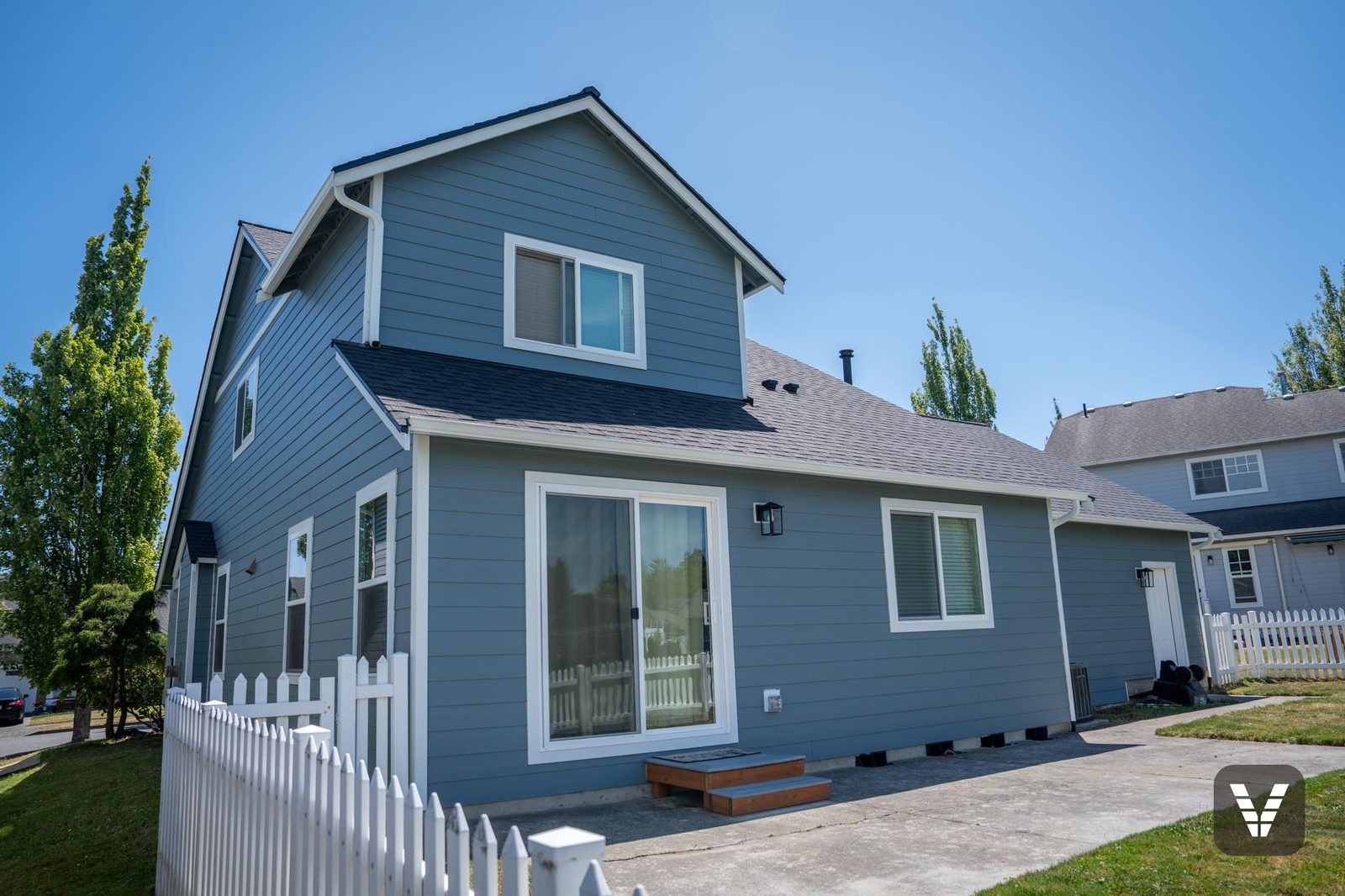
Window Replacement · Whatcom, Skagit, Island, San Juan & Snohomish Counties
Window replacement sealed against wind-driven rain.
Full-frame replacement, one opening or the whole house — our window installers strip to the rough opening, inspect for rot, flash every unit into the wall's weather barrier with sill pans where the assembly calls for them, and recommend brands by your goals, not a quota.
✓ Full-Frame Only — No Inserts
✓ Most Major Brands
✓ Rot Fixed, Not Covered
LIMITED TIME
$500 OFF New Windows
*7 window minimum
Request a free, no-obligation estimate — we'll recommend the right brand and install method for every opening.
★★★★★4.9/5 Rating
★★★★★5/5 Rating
★★★★★A+ Rating
No obligation, no pressure
WHY SIDING & WINDOW VAULT
The Edges Matter More Than the Glass
Most window failures in this climate are water failures at the joint between window and wall. Because we're an exterior contractor — siding, rot repair, and windows under one roof — every unit we set gets flashed and integrated into the weather barrier properly, and anything we find rotted around the opening gets rebuilt, not hidden.
✓Full-frame replacement only — never pocket inserts
✓Sill pans and flashing integrated into the weather barrier
The unit you pick matters — what happens at the edges of the opening matters more. Here's how we work.
1
IN-HOME CONSULTATION & PER-OPENING BID
WHY IT MATTERS
Every opening is different — a weather-facing picture window and a sheltered bathroom unit shouldn't get the same prescription.
WHAT YOU CAN EXPECT
✓Every opening measured and inspected
✓Brand and method recommended per window
✓An itemized bid, opening by opening
2
ORDERING & SCHEDULING
WHY IT MATTERS
Windows are built to order. Accurate measurements and a realistic timeline keep the project from stalling half-done.
WHAT YOU CAN EXPECT
✓Units ordered to verified measurements
✓Permits pulled when the scope needs them
✓A clear install window before we start
3
REMOVAL & OPENING INSPECTION
WHY IT MATTERS
The opening tells the truth once the old unit is out — rot and failed flashing get found now, not after the new window seals them in.
WHAT YOU CAN EXPECT
✓Old units removed one opening at a time
✓Framing inspected, rot documented and priced
✓Repairs completed before anything new goes in
4
FLASHING, SETTING & SEALING
WHY IT MATTERS
The joint between window and wall is where wind-driven rain gets in. This is the step that decides whether it ever does.
WHAT YOU CAN EXPECT
✓Sill pan and flashing sequenced correctly
✓Unit set plumb, square, and shimmed right
✓Air-sealed and insulated at the perimeter
5
TRIM, CLEANUP & WALKTHROUGH
WHY IT MATTERS
The job is done when every sash operates smoothly, the trim is finished, and you've signed off — not when the last unit goes in.
WHAT YOU CAN EXPECT
✓Interior and exterior trim finished clean
✓Every window operated and locked with you
✓Warranty paperwork handed over at walkthrough
Why We Don't Install Inserts
An insert replacement slips a new unit inside your existing frame. It's the industry's favorite method because it's fast and cheap to install and easy to sell at volume — but your old frame stays buried in the wall along with whatever rot it's hiding, the glass area shrinks with every re-frame, and the new window never ties into your wall's weather barrier.
In wind-driven-rain country, we think that's a shortcut your walls pay for later — so every window we install is full-frame, stripped to the rough opening where we can inspect the framing, set a sill pan, flash it properly, and stand behind the result. If another window replacement company's bid comes in dramatically cheaper, ask which method it prices.
Signs Your Windows Are Done
Fogging between panes means the seal has failed and the insulating gas is gone. Sashes that stick, won't stay open, or won't lock are past adjustment. Persistent condensation, drafts you can feel from across the room, and rot or soft trim around the frame are the wall telling you water is already getting in.
One failed window doesn't obligate a whole-home project — we replace single openings all the time. But if several windows are the same age, grouping them saves real money per unit, which is why the $500 offer starts at seven windows. Brand guidance lives on our Milgard, Andersen, Ply Gem, and Simonton pages.
Why Us
✓
Exterior Contractor, Not Just Installers
Siding, rot repair, and windows in one contractor
✓
Competitive Pricing
Milgard, Ply Gem, and Andersen — bid per opening
✓
Full-Frame Every Time
Down to the rough opening — no pocket inserts, ever
As a standalone project, standard vinyl windows typically run $1,100–$2,500 per window installed, highly dependent on brand, type, and size; composite windows typically run about 15–40% more. The biggest saving available: replacing windows during a re-side typically runs $900–$1,600 per window (20–35% less), because demolition, disposal, and administrative overhead are already carried by the siding project.
Prices change often with inflation, material costs, the economy, and tariffs and other policy changes, so these ranges are a guide, not a quote. Your written estimate has the current price for your home.
As a standalone project, a crew typically replaces at least a few full-frame windows a day, fewer where rot repair is needed; during a re-side it goes much faster, since the siding and trim around each window are already off. A whole-home window replacement typically runs three to seven days, depending on the size of the home and the number of openings. The pace depends on the crew size, the size of the windows, and how easy they are to reach — a ground-floor window goes faster than one three stories up — and on whether the old window has exterior trim and what kind of interior casing it has. Full-frame, nail-flange windows take longer than pocket inserts, but they give much better results and are a much better long-term investment. Openings are never left unsealed overnight: each window comes out and goes in the same day.
Yes. Each opening is exposed only briefly, we work one window at a time, and the room is closed back up before we move on. Washington's rainy season is more of a scheduling factor for exterior flashing work than a blocker.
We document it with photos, price the repair transparently, and rebuild the framing before the new unit goes in. Setting a new window into rotted framing is the one thing we won't do — it hides a problem you paid to fix.
Often not for like-for-like replacement, but changing opening sizes and egress-related work can require one, and municipalities differ. We know the local requirements, pull the permit when one is needed, and handle the inspection.
We're a supplier and installer of Milgard, Ply Gem, and Andersen, we install Simonton, and we've worked with most major brands over the years. The recommendation follows your budget, the opening, and the features you want.
Our standard Milgard V400 Tuscany windows, with SunCoat low-E glass and argon fill, typically rate about U-0.27 to U-0.29 depending on the style, and Andersen's 100 Series with standard low-E glass and argon rates about U-0.30; the lower the number, the better the window insulates. That meets the U-factor for PSE's $50-per-window rebate when you're replacing single-pane windows. PSE's $100 tier and Cascade Natural Gas's window rebate need U-0.22 or lower, which takes an upgraded glass package. We can help you with the rebate paperwork.
50% down when you approve the project, since the windows are custom-ordered for your openings.
Typically 2–4 weeks after ordering in the summer, and about 2 weeks in the off-season.
Yes. The windows carry the manufacturer's warranty — Milgard's V400 Tuscany comes with a lifetime limited warranty — and we provide a workmanship warranty on our installation.
As a standalone project, standard vinyl windows typically run $1,100–$2,500 per window installed, depending on brand, type, and size. Replaced during a siding replacement, they typically run $900–$1,600 per window (20–35% less), because the tear-off, disposal, and trim work are already part of the siding job. Composite windows, like Andersen's 100 Series, typically run about 15–40% more: roughly $1,450–$2,850 per window as a standalone project, or $1,250–$1,950 during a re-side. We bid per opening, measured on site and itemized. Estimates are free, and the $500 offer applies from seven windows up.
The one that installs them properly: installation matters more than the window brand or model. On a replacement, the siding, trim, flashing, and caulking are already on the wall, so the installer has to know what a siding contractor knows. Ask any bidder what they will do if they find rot, whether the windows are flanged or inserts, and how they flash the top of the window. We are a siding contractor and a James Hardie Elite Contractor as well as a window installer, and every window we install is full-frame and flanged.
For most people it comes down to the brand and who installs it, not the store. Both are typically where do-it-yourselfers buy windows they plan to install themselves, and both also sell installation done by local contractors rather than store employees. If you're paying for installation, ask whether it's a full-frame replacement or an insert set into the old frame, who repairs the trim and siding around the window, and who pays if they find rot.
Using our per-window ranges for standard vinyl windows, before sales tax: a smaller home or cottage (about 8–12 windows) typically runs $8,800–$30,000 as a standalone project or $7,200–$19,200 during a re-side; a mid-size home (about 13–20 windows) typically runs $14,300–$50,000 standalone or $11,700–$32,000 during a re-side; and a larger home (about 21–30 windows) typically runs $23,100–$75,000 standalone or $18,900–$48,000 during a re-side. Bigger projects typically land toward the lower end per window. Sales tax is added on the whole job at your address's rate, which varies by city and county — check the Washington Department of Revenue's website for the current rate at your address.
Typically, yes. Replacing every window in one project typically costs less per window than doing a few at a time, because setup, travel, and disposal happen once instead of on every visit. Phasing the work can ease a tight budget, but expect the total to come out higher.
Replacing a fogged or cracked pane typically runs $200–$600 per pane, depending on the window frame, the pane's size, its features — whether it's tempered, has grids (and which type), or is obscure privacy glass — and how many panes are replaced in the same visit; the more panes at once, the lower the price per pane typically gets. We replace panes as part of a larger project, like a re-side or a window replacement, but we don't offer pane replacement as a standalone service.
Picture (fixed) windows are typically the least expensive, since they have no moving parts. Sliders typically price about the same as single-hung windows, casements typically cost more than all three, and bay and bow windows typically sit at the top — in our experience they're also the most prone to failure. Custom combination windows, like a picture window over a slider, vary widely: some cost less than a bay or bow window, others more.
Vinyl, for most homes — it's the standard window we recommend. We typically suggest upgrading to a composite frame when the budget allows, or when the home has extra-large horizontal windows: vinyl is weaker than composite, and large horizontal vinyl windows tend to bow at the middle of the top frame. Andersen's 100 Series, a very popular composite window, is made of Fibrex, which Andersen says is two times stronger than vinyl, so it makes a better window and holds up better over the long term in those wide layouts. If you stay with vinyl for a large horizontal window, choose the manufacturer's thicker vinyl frame: Milgard's V400 Tuscany frame, for example, is 3-1/4 inches deep, compared with 2-7/8 inches for its V300 Trinsic, which gives it a slight edge.
For the longest life with the least upkeep, fiberglass is typically the best starting point: it's dimensionally stable, so it holds its shape through temperature swings, though it usually costs more than vinyl. Composite is a strong contender, but the word covers different formulas, so judge the specific product's construction and track record. Vinyl is often the best value: it resists moisture, needs little maintenance, and a well-made vinyl window can be a sensible long-term buy. Wood and clad-wood windows can last for generations with maintenance and repairs, and suit homeowners who value their look and repairability and accept more upkeep. We install fiberglass windows too, like Milgard's Ultra Series.
It depends on their condition, not just their age. Start by looking up the typical lifespan for your windows' frame material, like vinyl, aluminum, or composite. If they're getting close — and 20 years is close for many windows — watch more closely for the common failures: cracked or failing seals, fogged glass or condensation between the panes, clogged weep holes, and leaks that reach the inside of the home, which are sometimes a siding or flashing problem rather than the window itself. The most common sign is the seals breaking down over time, cracking and pulling apart, and windows that get the most sun typically fail first. Don't count the screens: they're separate from how the window works and inexpensive to repair.
Vinyl or composite frames, with picture (fixed) windows on the side facing the water. Salt air is hard on window hardware: a picture window has none to corrode, sliders and single-hung windows are fine too since most of their hardware is concealed, and crank-out windows — casements and awnings — have the most exposed hardware, which in our experience is the most prone to failure on waterfront homes. Vinyl, like Milgard's V400 Tuscany, and composite, like Andersen's Fibrex, hold up to salt air better than aluminum, which can corrode, or exposed wood. Where a series offers stainless or corrosion-resistant hardware, it's worth it near salt water, and check how the warranty treats homes close to salt water. On an exposed shoreline lot, make sure the window's design-pressure (DP) rating matches the wind exposure, especially on large view windows; use tempered glass on big openings and wherever code requires it, and low-E glass to cut solar heat on water-facing walls. Rinse hardware, tracks, and glass with fresh water a few times a year; some warranties make regular care a condition of coverage.
For most homes, no. Triple-pane windows are great, but our winters aren't nearly as cold as the places where triple-pane is common, like Alaska, so for most homeowners it's unnecessary, and that money is better spent elsewhere on the project. A quality double-pane window with a low-E coating and argon fill is what we install on most homes here.
No. A nail-flange (full-frame) window typically costs more to replace than a pocket-style insert, but for most homes it's a must-have: its nail fin is fastened and sealed to the house framing and taped with window flashing tape, which keeps the window from being drafty and keeps water out of the wall — critical in the Pacific Northwest. A pocket insert has no flange to seal or tape. Our professional experience has shown pocket inserts are a terrible fit for the Pacific Northwest, so we discourage them so strongly that we don't offer them at all.
It depends — on where you buy the windows and whether you're comparing the same tier. Big-box stores typically carry a brand's low-tier, builder-budget models, which aren't comparable to the mid-tier windows that are standard in replacement work; Milgard's entry-level V250 isn't a V400. Many contractors won't install windows a homeowner provides, especially established window replacement companies, and damaged units are slow to replace without an account with the manufacturer. Measuring is where most of these jobs go wrong — trusting someone else to measure, mixing up rough-opening and net-frame sizes (typically 1/2 inch apart), or measuring the inside or the wrong spot — and that 1/2-inch mix-up is a very common mistake we've seen force homeowners to reorder every window on the house, which ends up costing more than hiring a reputable window replacement contractor who orders, installs, and handles any support. If you supply your own, have your installer measure before you order.
Usually the off-season: the rainy and snowy months, roughly November through March. NOAA's climate averages for Bellingham show those months bring most of the year's rain and nearly all of its snow. We replace windows year-round, but the off-season is typically less expensive: it is the less convenient time for a homeowner, and manufacturers' lead times are typically shorter. You also don't have to wait for the off-season to ask for a quote. Request one in the busy season and ask about our Flex Schedule Discount, which we sometimes offer for work scheduled in our slow season.
WHERE WE WORK
Window Replacement Across Five Counties
From the Canadian border to north Seattle, plus the San Juans by ferry from Anacortes — these cities and surrounding areas. Pick your city for local project photos, permit notes, and reviews.